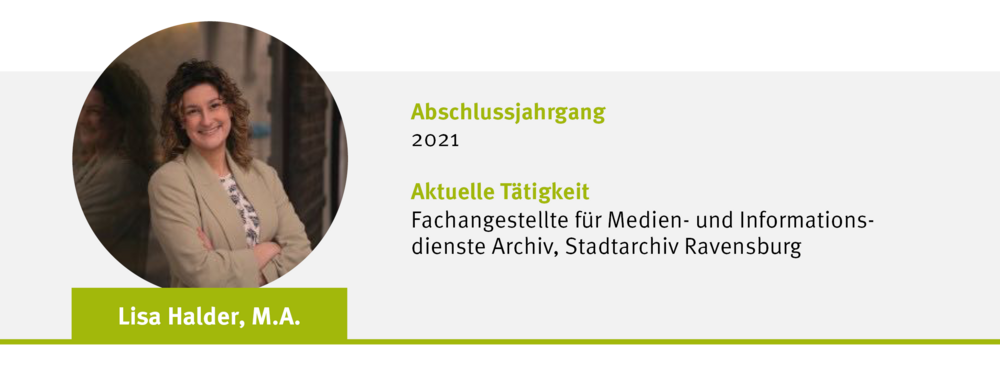
Lisa Halder
Why did you choose the Medieval and Early Modern Studies degree programme?
I discovered my passion for older German literature during my Bachelor's degree in German Studies, was a tutor in the ÄDL and was involved in exciting research projects. I liked the opportunity to specialise in this field from an interdisciplinary perspective.
What did you particularly like about your degree programme?
The insights and active participation in current research topics. Critical questioning and independent thinking also seemed to be encouraged and helped to advance my own scientific work. Of course, great fellow students and good lecturers were also a big plus.
What was the most surprising thing about your degree programme for you?
Participating in research projects opened the door to discovering new things myself. Every assignment gave me the feeling that I wasn't just regurgitating the familiar, but generating real added value. Now - years later - I can see in my professional contacts that projects are still progressing and results are becoming better and better and more and more applicable, in which I was also a small cog in the early stages.
What did you originally want to be and what do you actually do today?
I would probably have chosen a different path if I had had a specific career in mind beforehand. It was only during my studies that I realised that archiving or museum work sounded interesting to me.
What does a typical working day look like for you?
Working in a municipal archive with historical collections may sound dull at first, but it is extremely varied. I can usually organise my tasks myself and they consist of Listing, cataloguing, preservation, retroconversion, user service, administration and many other things. Answering user enquiries leads to a wide variety of fields such as family research, urban history, historical research... Every day is different and there is always something to do - whether analogue or digital.
How did your studies prepare you for your current job?
Palaeographic knowledge was a basic requirement, so to speak. So was knowledge of historical language levels, because understanding primary sources is essential for cataloguing work. However, I get the most benefit from the areas that I used voluntarily and of my own accord during my studies.
What advice would you like to give future students?
It is probably wise to think in advance about where your professional journey should take you and which jobs are realistic. Archives in particular require specialised (administrative) training/studies and the chances of a career changer are only good as long as there is a shortage of skilled workers. So you should definitely put out feelers and go into practice during your studies. In addition, as a humanities graduate, a certain degree of willingness to compromise is necessary when it comes to the final choice of job, as well as the willingness to continue training.